

A few weeks ago, we explored the moment a rental property stopped being just another rental and became an asset. Last week, we looked beyond monthly cash flow and asked a different question: Is the asset actually performing? Those conversations lead naturally to another question every long-term owner eventually faces: How do you protect that performance?
Most owners assume protecting an investment requires making major decisions. In practice, many of the decisions that shape a property’s long-term performance are much smaller and far quieter. They arrive as routine maintenance recommendations that do not appear especially urgent.
At Real Property Management Regions, these conversations happen almost every day. An inspection identifies loose roof flashing. An HVAC technician recommends servicing a system before the hottest part of summer. A contractor notices deteriorating exterior sealants, or someone points out that water is no longer draining away from the foundation as effectively as it once did. None of these recommendations is dramatic. The resident is comfortable, rent continues arriving, and the home appears to be functioning exactly as it should. From an owner’s perspective, asking whether the work can wait is both logical and responsible.
Sometimes it can. The challenge is recognizing when it should not.
When Small Decisions Become Expensive Ones
One of the more interesting realities of rental property ownership is that the most expensive decisions rarely look expensive when they are first made. They often arrive disguised as ordinary maintenance recommendations because the consequences remain hidden long before they become visible.
Managing homes throughout the Virginia Northern Neck, Middle Peninsula, and Caroline County reinforces that observation every day. Some of the properties we oversee have stood for generations along the Potomac River and its tributaries. Others are newer homes built with modern materials and mechanical systems. Every property ages differently, but they all tend to communicate in similar ways. They usually give owners an opportunity to prevent a larger problem before they require someone to solve it.
The challenge is that opportunity rarely arrives looking urgent.
A small gap in exterior sealant allows moisture to enter where it should not. Water begins collecting a little closer to the foundation after heavy rain. An HVAC system starts working harder to maintain the same temperature it achieved with ease only a year earlier. None of these conditions creates an immediate emergency, which is precisely why they are so easy to postpone. Life gets busy, priorities compete for attention, and the property continues to perform well enough that waiting feels reasonable.
Experienced owners eventually stop asking only, “Can this wait?” They begin asking a better question: “What will waiting cost?” That subtle shift changes the way every maintenance recommendation is evaluated.
That’s where maintenance stops being a repair conversation and becomes an investment conversation.
When Property Management Becomes Asset Management

Most people purchase rental property because they want to build long-term wealth. Some focus on monthly income. Others are drawn to appreciation or the opportunity to create greater financial security over time. Far fewer owners are introduced to the complete framework Real Property Management Regions uses when discussing investment performance: the Four Pillars of Real Estate Investment, cash flow, appreciation, depreciation, and amortization.
Viewing a property through all four pillars changes the conversation. Maintenance is no longer simply about repairing a house. It becomes part of a broader strategy for protecting the investment.
Addressing failing flashing or deteriorated exterior sealants is not merely a line-item expense. It is an effort to keep moisture from reaching the structure behind the exterior materials. Servicing an HVAC system helps extend the useful life of expensive equipment, reduces the likelihood of emergency repairs during peak seasons, supports resident satisfaction, and contributes to predictable cash flow. Correcting drainage before water reaches the foundation helps preserve the condition that supports long-term appreciation while reducing the likelihood of avoidable repair costs.
Viewed through that lens, maintenance stops looking like an expense and starts looking like stewardship.
Every maintenance recommendation is really an investment recommendation wearing work clothes.
That idea represents one of the most important differences between property management and asset management. Property management focuses on operating the home successfully today. Asset management asks a broader question: How will today’s decision influence the long-term performance of the investment?
Both perspectives matter. Long-term wealth is rarely built through one extraordinary decision. More often, it is built through hundreds of thoughtful operational decisions that consistently protect the Four Pillars of Real Estate Investing.
Owners who are considering professional management can explore the Wealth Optimizer for prospective owners to learn how Real Property Management Regions applies this framework when evaluating rental-property performance. Current clients can use the Wealth Optimizer client resources to continue reviewing their properties through the same investment lens.
Protecting Your Ability to Choose
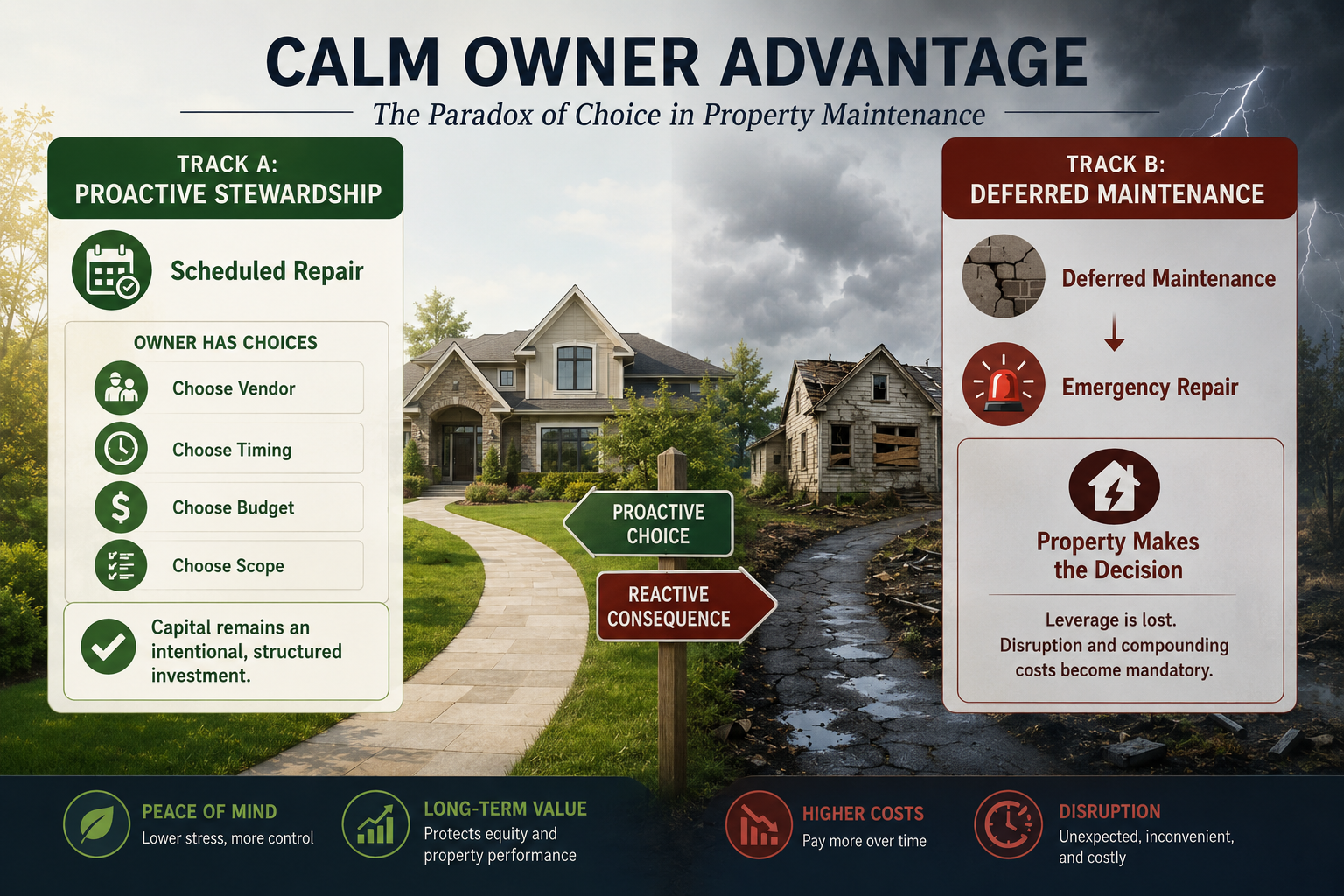
Proactive maintenance gives rental property owners the ability to choose the timing, budget, contractor, and scope of repairs. Deferred maintenance often removes those choices, resulting in emergency repairs, higher costs, and unnecessary disruption.
Preventive maintenance is often misunderstood. Its purpose is not to eliminate repairs altogether. Every roof eventually reaches the end of its service life. HVAC systems wear out. Water heaters fail. Buildings age because that is what buildings do.
The real purpose of preventive maintenance is simpler: it protects an owner’s ability to choose.
When maintenance concerns are addressed early, owners typically decide when the work will be completed, who will perform it, how the project fits into the budget, and how to minimize disruption for the resident. Those choices allow maintenance to remain a planned investment rather than an emergency expense.
Once those choices disappear, the property begins making them instead. Emergency service replaces scheduled maintenance. Secondary damage increases the scope of the repair. Residents experience unnecessary inconvenience. Budgets become reactive rather than intentional. The conversation changes because the owner is no longer deciding whether to act; the property has already made that decision.
That is why stewardship matters.
The Quiet Success of Good Stewardship
One of the quiet ironies of rental property ownership is that the most successful maintenance decisions are the ones nobody remembers. The roof never leaked. The crawlspace never flooded. The resident never lost air conditioning during the hottest week of July. Nothing remarkable happened because someone recognized an opportunity to act before the property demanded attention.
Success in asset management rarely announces itself. More often, it appears as predictable expenses, consistent occupancy, residents who choose to renew, building systems that achieve their expected service life, and owners who make decisions from a position of planning rather than urgency.
Those outcomes are rarely accidental. They are the product of thoughtful stewardship repeated consistently over time. Owners invest in rental property because they believe real estate can create lasting wealth. Protecting cash flow, supporting appreciation, preserving the physical asset connected to depreciation planning, and allowing amortization to build equity are not achievements secured on closing day. They are strengthened by the decisions owners continue making throughout the life of the investment.
That is why the repairs that cost the least usually save the most—not simply because they are inexpensive, but because they preserve the owner’s ability to choose while protecting the performance of the investment itself.
The Calm Owner’s Perspective
Every rental property will require maintenance. The difference is not whether repairs occur; it is whether owners recognize the opportunity to address small concerns before they become larger, more expensive decisions. Asset performance is rarely determined by one major repair or one extraordinary investment. More often, it is shaped by ordinary decisions that quietly preserve the property’s condition, protect the resident experience, and strengthen long-term financial performance.
That perspective changes the role of maintenance. It is no longer simply a cost of owning real estate. It becomes one of the disciplines of stewardship.
Owners who consistently build wealth through rental housing are not necessarily the ones who spend the most money or own the largest portfolios. More often, they are the ones who understand that timing matters. They recognize the difference between spending money and protecting an investment, and they make thoughtful decisions while those decisions are still theirs to make.
That is the quiet advantage of viewing a rental property as an asset instead of simply a source of monthly income.
Continue the Conversation
Owners evaluating a specific property may also find value in requesting a professional rental analysis.
- Free Rental Analysis: Request a Professional Rental Analysis
Recommended Resources
The Calm Owner Advantage Series
This editorial is part of an ongoing series exploring thoughtful ownership, operational excellence, and long-term real estate asset management.
- Part 4 – The Day the Rental Became an Asset
- Part 5 – Rental Property Asset Performance
- Part 6 – The Repairs That Cost the Least Usually Save the Most (Current)
- Coming Next: Part 7 – The Turnover Window
About The Calm Owner Advantage
The flagship weekly editorial series from Real Property Management Regions exploring property management, asset management, maintenance, operations, and building long-term wealth through rental real estate.
Protect your asset. Build your legacy. Level Up.
We’ll continue the conversation next week in Part 7 of The Calm Owner Advantage.
This content is provided for general informational and educational purposes only and does not constitute financial, legal, tax, or investment advice. Readers should consult with licensed professionals regarding their specific circumstances.
We are pledged to the letter and spirit of U.S. policy for the achievement of equal housing opportunity throughout the Nation. See Equal Housing Opportunity Statement for more information.
