

The Calm Owner Advantage
A weekly column on property management, asset management, maintenance, and building long-term wealth through rental real estate.
When Cash Flow Isn’t Telling the Whole Story
One of the more persistent assumptions in rental housing is that a property producing positive cash flow must also be performing well.
It is an understandable conclusion. The home is occupied, rent is collected on time, expenses are paid, and the monthly owner statement ends with money left over. From a distance, everything appears to be working exactly as intended.
After years of managing rental properties throughout the Virginia Northern Neck, Virginia Middle Peninsula, and Caroline County, I have learned that cash flow and asset performance are closely related, but they are not the same thing.
Some of the strongest-performing assets in a portfolio do not necessarily produce the highest monthly returns. At the same time, some properties that appear profitable on paper quietly lose ground year after year in ways that never appear on a monthly owner statement.
That distinction becomes important because rental properties are rarely purchased simply to generate income for the next thirty days. Most owners invest in real estate to build long-term wealth. Cash flow contributes to that objective, but it represents only one measure of whether an asset is truly performing.
Last week, I wrote about the moment a rental became an asset. That article explored the shift in perspective that occurs when owners stop viewing a property simply as a rental and begin evaluating it as a long-term investment.
That transition naturally leads to another question: how do you know whether your asset is actually performing?
Looking Beyond the Monthly Statement
One of the advantages of managing a diverse portfolio is that patterns eventually begin to emerge.
Some properties are waterfront homes exposed to years of humidity, salt air, and coastal weather. Others are newer homes throughout Caroline County with entirely different maintenance cycles. Many belong to military families stationed at Naval Support Facility Dahlgren who unexpectedly became landlords after receiving orders to relocate. Others entered the rental market after retirement, an inheritance, or a change in family circumstances.
Although every property has its own story, the highest-performing assets almost always share one characteristic: their owners evaluate performance differently.
They do not simply ask whether rent was collected this month. They ask whether every decision is making the asset stronger. That distinction influences nearly every aspect of professional property management and rental property asset performance.
Performance Is More Than Profit
A positive owner statement can create a false sense of security.
A property can generate excellent cash flow while deferred maintenance quietly accumulates. Building systems continue aging whether they are discussed or not. Caulking deteriorates. Roofs lose years of useful life. HVAC equipment becomes less efficient. Water intrusion that appears insignificant today often becomes tomorrow’s flooring replacement or drywall repair.
None of those realities immediately appear on a profit-and-loss statement. Eventually, however, every one of them appears in the asset’s long-term performance.
Professional asset management recognizes that maintenance is rarely just maintenance. Preventive maintenance protects building systems. Capital planning extends useful life. Routine inspections identify developing issues before they become expensive failures. Every maintenance decision is also an investment decision.
Resources from the U.S. Department of Housing and Urban Development reinforce the importance of maintaining healthy, safe housing, which protects both residents and the long-term condition of the property.
Operational Excellence Creates Asset Performance
Many people think property management is primarily about collecting rent and coordinating repairs. Those responsibilities certainly matter. They simply are not the whole job.
Operational excellence influences asset performance just as much as maintenance does. Routine inspections identify concerns before residents discover them. Thoughtful turnover execution reduces vacancy while preserving quality. Strong vendor relationships improve consistency, response times, and workmanship. Clear communication keeps owners informed and residents confident that concerns are being addressed professionally.
Individually, each process seems relatively small. Collectively, they determine whether an asset becomes more predictable or more reactive over time.
Organizations such as the National Association of Residential Property Managers emphasize professional standards and operational consistency because effective management systems directly influence long-term rental property performance.
Strong systems rarely make headlines. They quietly improve performance year after year.
Resident Experience Matters More Than Many Owners Realize
One of the most overlooked contributors to asset performance is the resident experience.
Residents who feel heard tend to communicate maintenance concerns earlier. Residents who live in well-maintained homes are generally more likely to care for the property themselves. Residents who experience responsive communication are often more willing to renew their leases.
Every renewal avoids vacancy costs, marketing expenses, cleaning, turnover labor, and leasing commissions. What appears to be good customer service is often sound asset management.
Resident experience and financial performance are not competing priorities. They are connected.
Asset Managers Measure Different Things
One of the biggest differences between traditional property management and asset management is not found in the services provided. It is found in what gets measured.
Property management asks whether the property is operating. Asset management asks whether the property is improving.
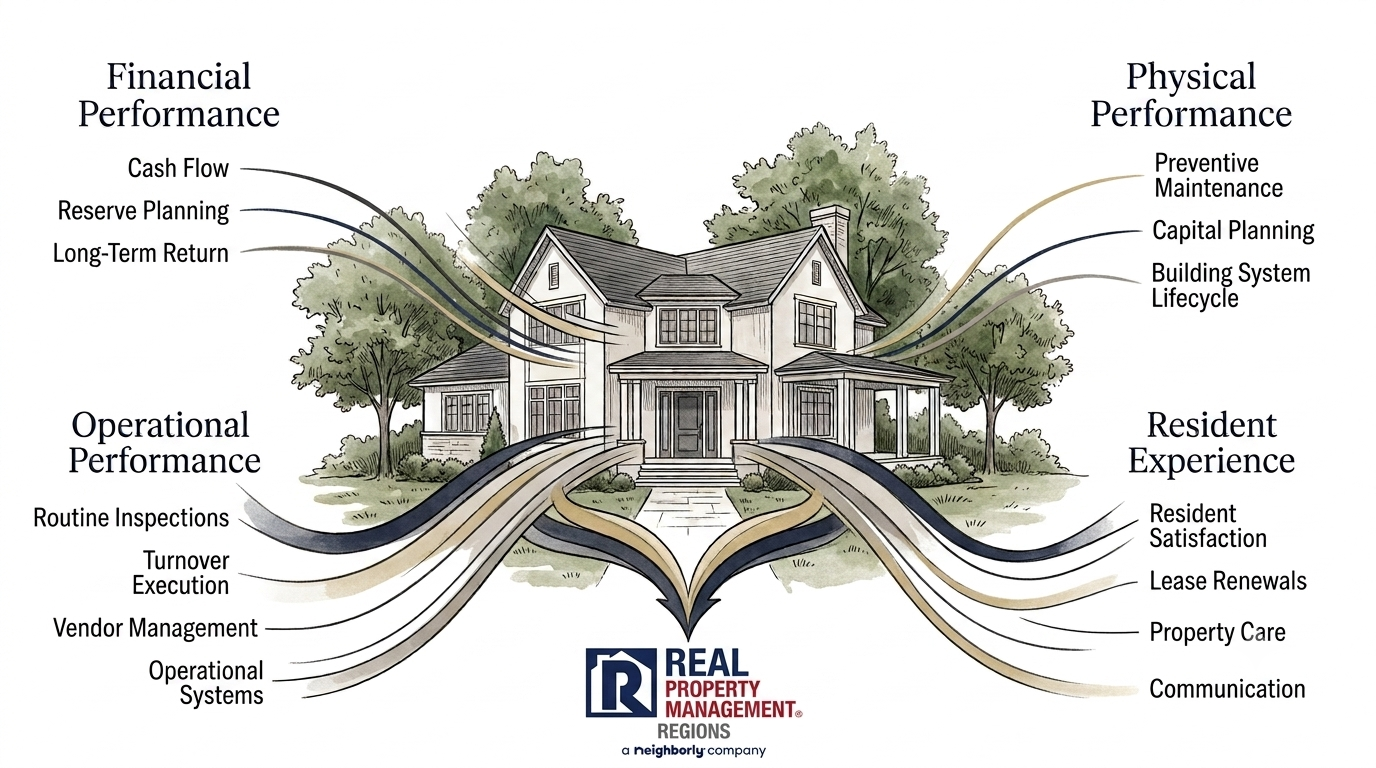
Cash flow, preventive maintenance, capital planning, routine inspections, vendor performance, resident satisfaction, and operational systems each contribute to the overall health of the investment. Viewed independently, they seem like ordinary property management activities. Viewed together, they become indicators of long-term asset performance.
That is why our conversations with owners often extend well beyond repairs, rent collection, or lease renewals. We are evaluating how today’s decisions influence tomorrow’s results.
The Long View
One of the most rewarding parts of this business is watching owners change the questions they ask.
Early conversations usually focus on monthly income, expenses, and occupancy. Over time, those discussions evolve into conversations about lifecycle planning, capital improvements, resident retention, operational efficiency, appreciation, and long-term portfolio performance.
That shift does not happen because the property changes. It happens because the owner does.
The strongest portfolios are not built by chasing the highest monthly return. They are built by making hundreds of thoughtful decisions that improve the performance of the asset year after year.
Cash flow matters. It always will. But it should never become the only measure of success.
Because the best-performing assets are rarely the ones producing the highest income today. They are the ones positioned to create the greatest value tomorrow.
For owners wondering whether their property is performing as well as it could, a professional rental analysis can help identify opportunities before they become expensive surprises.
Series Reflection
Strong owners eventually stop measuring success by a single number. They begin evaluating how maintenance, operations, resident experience, and financial performance work together to strengthen the asset over time. That shift does not just improve a property. It changes the way long-term wealth is built.
Next Week Preview
Next week, we will examine another principle that separates high-performing rental portfolios from the rest: why the most expensive repairs often begin as the smallest maintenance decisions.
Protect your asset. Build your legacy. Level up.
This content is provided for general informational and educational purposes only and does not constitute financial, legal, tax, or investment advice. Readers should consult with licensed professionals regarding their specific circumstances.
We are pledged to the letter and spirit of U.S. policy for the achievement of equal housing opportunity throughout the Nation. See Equal Housing Opportunity Statement for more information.
