

Editorial Series | The Calm Owner Advantage
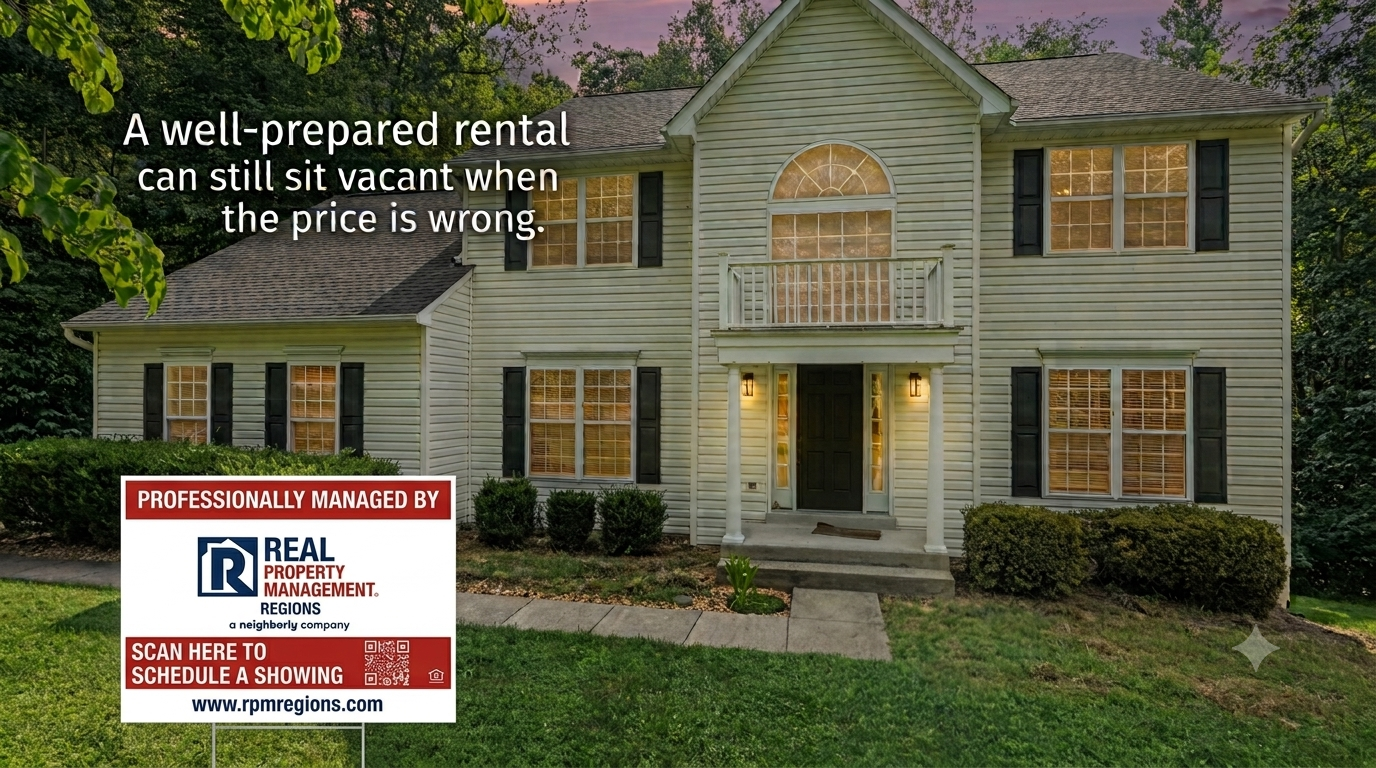
What those improvements cannot do is create demand that does not exist.
Suppose the property’s location, condition, competition, and current demand support approximately $2,300 per month. Spending money on improvements does not automatically transform it into a $3,000 or $3,300 rental.
Prospective residents will still compare the home with the other properties available to them. Unless it offers a meaningful difference that justifies the additional cost, the market will respond accordingly. The owner chooses the asking rent, but the market determines whether that rent is supported.
Why a Market-Supported Range Matters
A sound rental property pricing strategy should not begin with the owner’s mortgage payment, renovation budget, or desired monthly return. Those figures are important when evaluating the investment. However, they do not determine what a qualified resident is willing to pay.
A professional rental analysis should identify a supportable range and recommend the property’s strongest starting position. That recommendation should reflect the home’s condition, location, features, current competition, and demand within that particular market.
Public benchmarks such as HUD Fair Market Rents can provide useful context. Broader U.S. Census Bureau housing-vacancy data can also help owners understand general trends. Neither replaces a property-specific evaluation of current competition, condition, presentation, timing, and local demand.
That local context matters because rental markets across our service area do not all behave the same way. A rural home in the Northern Neck may move differently from a property near Dahlgren in King George. A commuter-focused home in Caroline County may also perform differently from a waterfront property in Westmoreland County.
Even similar homes can produce different results. Presentation, availability, property condition, and surrounding competition all influence how the market responds.
For example, the available evidence may indicate that a property should rent between $2,550 and $2,700 per month. Based on its condition and competitive position, we may recommend entering the market at $2,650.
An owner may reasonably ask to test $2,700 or slightly more. Under the right circumstances, that may be worth considering. There is a meaningful difference, however, between testing the upper end of a supported range and ignoring the range altogether. One is a calculated market test; the other is an unsupported expectation.
A Higher Price Needs a Vacancy Plan
At Real Property Management Regions, we listen to our owners. It is their property, their investment, and ultimately their decision. When an owner wants to begin above our recommendation, we explain the possible reward and the vacancy exposure that may come with it.
We also establish a vacancy plan before the property enters the market. Its purpose is to make sure the home does not sit indefinitely while the market continues giving us the same answer.
The exact strategy will depend on the home, its location, its presentation, and the available competition. We also consider the response the property receives after entering the market.
If the expected activity does not occur, we review the strategy and make the appropriate adjustment. That may mean reconsidering the price, strengthening the property’s presentation, introducing a limited incentive, or making another strategic change based on what the market is telling us.
A higher asking rent can be part of a strategy. Allowing an overpriced property to remain untouched while vacancy continues to grow is not asset management.
The Mathematical Reality of Vacancy Loss
Consider a property that the market supports at approximately $2,300 per month. The owner decides to test $2,400, hoping to earn an additional $100 each month.
If the property leases promptly, the decision may work. If the higher price creates one additional month of vacancy, however, the first-year numbers tell a different story.
Twelve months at $2,300 produces $27,600 in gross rental income. Eleven months at $2,400 produces $26,400. Even though the monthly rent is higher, the property produces $1,200 less during the year.
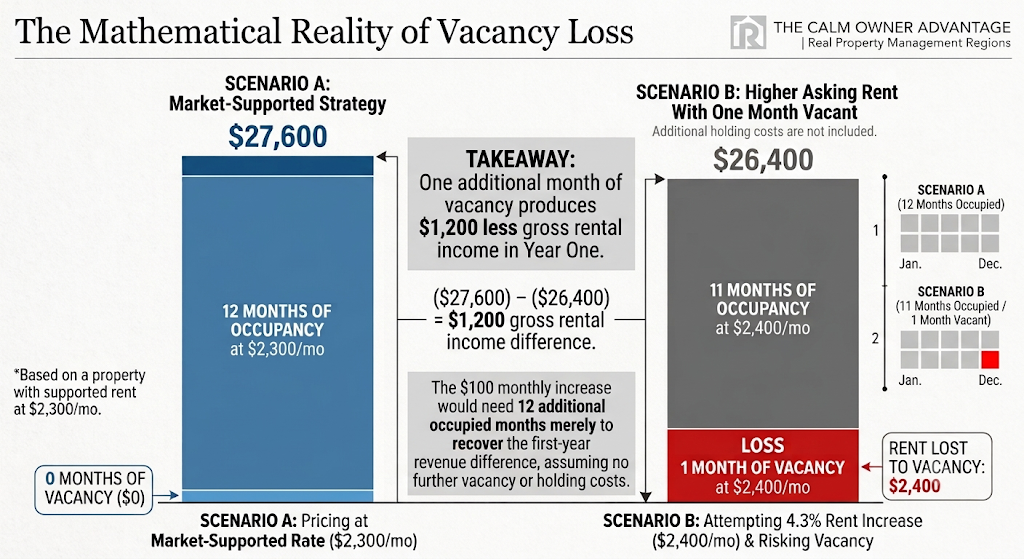
That calculation does not include utilities, lawn care, property checks, or the additional risk associated with leaving a home vacant. It also does not account for qualified applicants who may have leased another property while the owner waited for a price the market was not prepared to support.
That is the mathematical reality of vacancy loss. The strongest return is measured across the entire year, not by the highest number printed on the lease.
Where Asset Management Begins
A traditional property-management approach may focus primarily on listing the home and finding a resident. An asset-management approach considers the investment’s broader performance.
It looks at vacancy exposure, qualified demand, annual income after vacancy, and the plan if the market does not respond as expected. Those questions help protect the asset.
The purpose of a professional rental analysis is not to provide the highest number an owner wants to hear. It identifies what the market appears to support, recommends an intelligent starting position, explains the tradeoffs, and establishes a plan that can adapt to real-world feedback.
The owner’s goals remain part of the conversation, but the market must also have a voice. Property management gets the home listed. Asset management considers whether the property is positioned to produce the strongest sustainable return. It also considers what should happen next if the original strategy does not produce the expected response.
Owners who want to evaluate their property beyond the monthly rent can explore the Real Property Management Regions Wealth Optimizer. That is the difference between waiting on the market and managing the investment.
Continue the Conversation
Preparing to place a rental property on the market? Real Property Management Regions provides owners throughout the Virginia Northern Neck, Middle Peninsula, Caroline County, King George, and surrounding communities with a professional rental analysis and a strategic plan for positioning the property.
Request a Professional Rental Analysis
Protect your asset. Build your legacy. Level Up.
The Calm Owner Advantage Series
This editorial is part of an ongoing series exploring thoughtful ownership, operational excellence, and long-term real estate asset management.
- Part 6 — The Cost of Deferred Maintenance in Rental Properties
- Part 7 — Vacancy Isn’t the Problem. Wasting It Is.
- Part 8 — The Highest Rent Is Not Always the Best Return
- Coming Next: Part 9 — Why the First Highly Qualified Applicant Matters
This content is provided for general informational and educational purposes only and does not constitute financial, legal, tax, or investment advice. Readers should consult with licensed professionals regarding their specific circumstances.
We are pledged to the letter and spirit of U.S. policy for the achievement of equal housing opportunity throughout the Nation. See Equal Housing Opportunity Statement for more information.
