


At Real Property Management Regions, we do not look at a rental property as simply a house that needs a tenant, a lease and somebody to answer maintenance calls. We look at it as an asset.
That difference matters. If all we are doing is collecting rent, renewing leases and reacting when something breaks, we may be managing the tenancy, but we are not necessarily managing the investment. Our approach is built around an asset management mindset: understanding how the property is performing today, what could affect that performance tomorrow, what decisions are coming, where the risks are and whether the choices being made now are helping or hurting the owner’s long-term position.
That is really what The Calm Owner Advantage has been about from the beginning.
For the past few months, I have used most Mondays to write about the decisions that come with owning rental property. Some weeks we talked about money. Other weeks it was maintenance, vacancy, residents, pricing, applications or whether managing the property yourself is still worth the time it takes. Last week, we talked about looking ahead and making a plan before fall turns into winter and another year gets away from us.
If this is the first article in the series you have read, there is probably an earlier conversation that fits wherever you are with your property right now. We have asked “Would You Hire Yourself to Manage Your Rental Property?” We have looked at “The Cost of Waiting,” why the highest rent is not always the best return, why the first highly qualified applicant matters and why a rental property needs more than a tenant, it needs a plan.
Those sound like different subjects, but looking back now, they were all pointing in the same direction: good rental property ownership is about protecting the asset and creating options before you need them.
The Decisions Are Easier Before They Become Urgent
A lot of what we deal with in property management comes down to timing.
A small maintenance issue is easier to think through while it is still a small maintenance issue. Once water is coming through the ceiling or the HVAC stops working in the middle of summer, the conversation changes. At that point, you are no longer deciding whether to address it. You are deciding how quickly somebody can get there and what it is going to cost.
The same thing happens with vacancy. If the market is telling us during the first week or two that a property is priced too high, we still have options. If we ignore those signals for a month because we are holding out for a particular number, lost rent has already made part of the decision for us. Renewals, capital expenses and reserve balances work much the same way.
That does not mean owners should always move quickly or spend money because something might happen. Sometimes waiting is absolutely the right call. The important part is understanding why we are waiting. There is a big difference between choosing to wait because the information supports it and doing nothing because nobody stopped long enough to make a decision.
That is where an asset management mindset matters. Instead of asking only what something costs today, we also have to consider what today’s decision could mean at the next turnover, next renewal or several years down the road.
The Property Does Not Care What We Want the Answer to Be
One of the themes I have returned to throughout this series is separating what we want from what the property is actually telling us.
Owners know what they paid for a house. They know how much they have invested in it. They may know exactly what rent they want or what return they believe the property should produce. I understand that. I am a business owner too. Nobody enjoys hearing that the number they had in mind may not be the number the market supports.
But the market still gets a vote.
That was the point behind our conversation about why the highest rent does not always produce the highest return. An additional $100 a month sounds great until trying to capture that $100 creates three more weeks of vacancy. It is also why we spent time talking about qualified applicants. Once fair screening criteria are established and someone meets them, continuing to wait because maybe an even stronger applicant will appear creates another kind of risk.
Strong residents deserve to be part of the asset conversation too. A resident who pays consistently, cares for the home and communicates with management has value that does not always show up in a simple comparison of monthly rents.
None of this means lowering standards or giving up on improving returns. It means looking at the entire picture rather than chasing the biggest number in one column.
Sometimes the Best Property Management Is Pretty Boring
I think this is one of the things people misunderstand about professional property management.
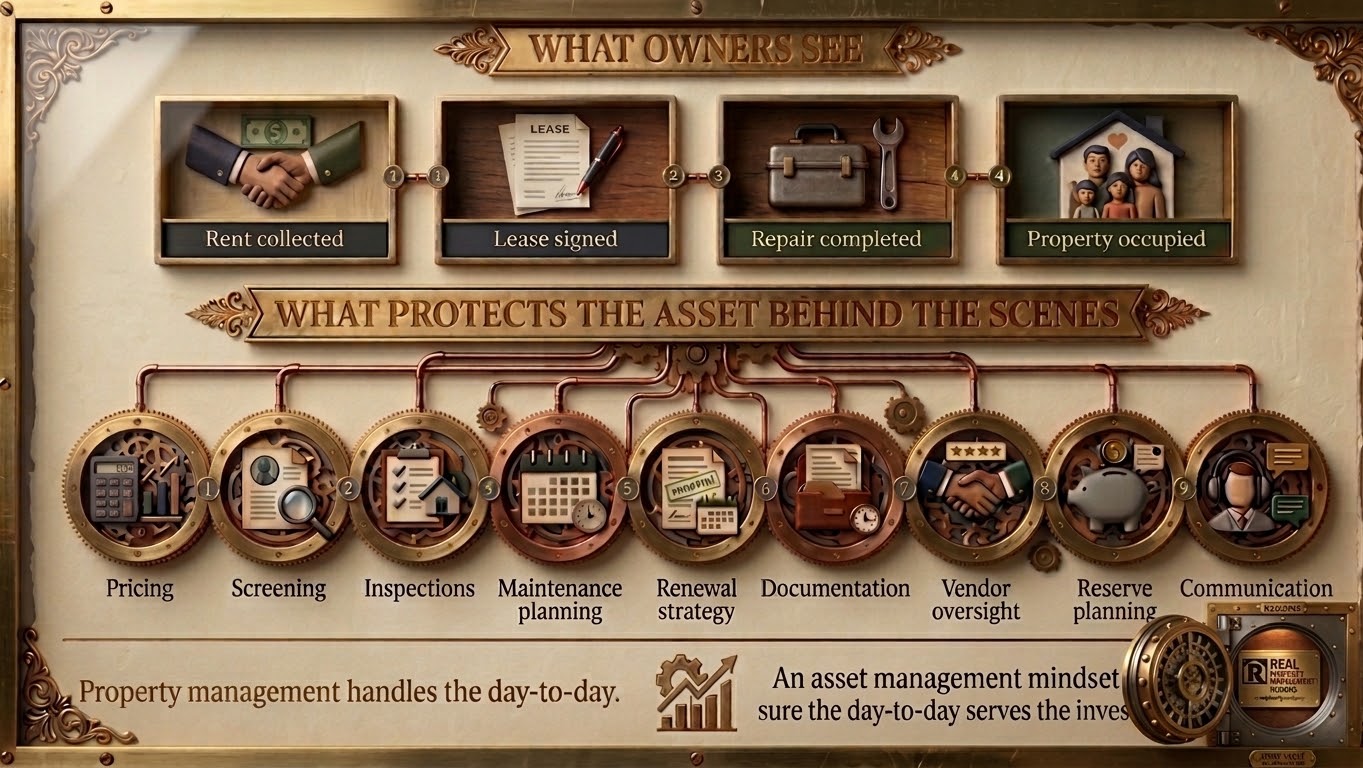
A lot of good management is not particularly dramatic. The repair gets addressed before it becomes an emergency. The renewal conversation starts early. The rent is adjusted before vacancy gets out of hand. The resident gets an answer. The owner knows what is happening, and the documentation is there if somebody needs it later.
Nobody makes a movie about any of that, but those small, uneventful decisions are often what protect the asset.
It is easy to notice property management when something goes wrong. What is harder to see are all the things that never became larger problems because somebody dealt with them early. That is one of the things I wanted owners to see through this series. Property management is the day-to-day work. The asset management mindset makes sure that day-to-day work still serves the bigger investment.
Which Brings Me Back to the Goal
After spending the past few months writing The Calm Owner Advantage, I think I can sum it up pretty simply: the goal was never to own a problem-free rental property.
I do not think that property exists.
Things break. Residents move. Markets change. Contractors miss appointments. Appliances die at the worst possible time. A house that performed perfectly well last year may need a different strategy this year. That is real estate.
Professional management does not make those things disappear, either. I would never tell an owner that hiring a property manager means nothing will go wrong. What good management can do is put structure around the uncertainty.
It can help identify the maintenance issue earlier, provide real market information before a pricing decision, establish standards before an application arrives, begin the renewal conversation before everyone is staring at a deadline and help prepare for an expense instead of being completely surprised by it. Maybe most importantly, it can help keep one problem from turning into three.
That is where I think the word calm really belongs. Calm does not mean passive, and it certainly does not mean ignoring problems and hoping everything works itself out. It means having enough information, planning and perspective that every issue does not have to become a crisis.
If you have followed this series from the beginning, thank you for reading. If you are just joining us, go back through the earlier conversations and start with whatever challenge looks most familiar. Maybe it is pricing, self-management, vacancy, maintenance or planning for expenses you know are coming. You do not have to start with the first article.
Wherever you begin, the larger question remains:
Are we simply managing the next problem, or are we managing the asset?
You will not prevent every vacancy, avoid every repair or predict every change in the market. But you can know your property and your numbers. You can plan ahead, make decisions while you still have options and respond from a position of information instead of panic when circumstances change.
That, to me, is The Calm Owner Advantage.
While this series ends today, the conversation does not. Starting next Monday, we are going to move from the mindset behind owning a rental property to what professional property management actually looks like in practice — the systems, standards and day-to-day decisions owners do not always see, but that can make a very real difference in how an asset performs.
Different conversation. Same asset management mindset.
This content is provided for general informational and educational purposes only and does not constitute financial, legal, tax, or investment advice. Readers should consult with licensed professionals regarding their specific circumstances.
We are pledged to the letter and spirit of U.S. policy for the achievement of equal housing opportunity throughout the Nation. See Equal Housing Opportunity Statement for more information.
